Нео у земљи чуда: Луис Керол, Матрикс и проблем језика
Сажетак
У овом раду полази се од отвореног интертекстуалног позивања на дела Луиса Керола које се може наћи у серијалу филмова Матрикс. После прелиминарних опаски о наративним и структуралним сличностима између ових дела, прелази се на начин на који она третирају проблем језика. Наиме, језик се у њима представља као поље које је у стању да концептуално детерминише слику света и према томе усмерава и људско размишљање, а сходно томе и практично поступање. И код Керола и у Матриксу питање слободе блиско је повезано са свешћу о моћи језика и с њима повезаног утицаја формалне логике и управљања наративом. Слобода се поставља као слобода од устаљеног размишљања и већ фиксираних концепата. С друге стране, постизање слободе не поставља се у контексту напуштања језика, те ни концептуалног мишљења, већ управо у овладавању њима. Алиса у Земљи чуда мора да савлада језик и постане „господар значења речи“, док Нео у Матриксу мора да овлада бинарним кодом којим се служи вештачка интелигенција. То је једини начин да се избегне да језик, односно, рачунарски код управља човеком и његовом судбином. Са стране система, долази до непредвидљивости; са стране човека, јавља се слобода.
Референце
Carroll, Lewis. Alice’s Adventures in Wonderland & Through the LookingGlass. Hertfordshire: Wordsworth Editions Limited, 2001.
Достојевски, Фјодор Михајлович. Забелешке из подземља. Прев. Бранка Ковачевић. Подгорица: Октоих, 2007.
Shakespeare, William. The Tempest. Oxford: Oxford University Press, 2008.
The Matrix Reloaded: Wachowski, Lana, and Lilly Wachowski, directors. The Matrix Reloaded. Warner Bros., 2003.
The Matrix Revolutions: Wachowski, Lana, and Lilly Wachowski, directors.
The Matrix Revolutions. Warner Bros., 2003.
The Matrix: Wachowski, Lana, and Lilly Wachowski, directors. The Matrix. Warner Bros., 1999.
Neo in the Wonderland: Lewis Carroll. The Matrix and the Issue of Language.
Allen, Ricky Lee. “Wake Up, Neo: White Identity, Hegemony, And Consciousness In “The Matrix””. Counterpoints, 2002, Vol. 209, The Freirean Legacy: Educating for Social Justice (2002): 104–125.
Bartlett Laura and Byers, Thomas B. “Back to the Future: The Humanist “Matrix””. Cultural Critique, No. 53, Posthumanism (Winter, 2003): 28–46.
Beghetto, Robert G. Monstrous Liminality: Or, The Uncanny Strangers of Secularized Modernity. “The Sacredness of Digital Liminality”. London: Ubiquity Press, 2022: 123–143.
Bivona, Daniel. “Alice the Child-Imperialist and the Games of Wonderland”. Nineteenth-Century Literature, Vol. 41, No. 2 (Sep., 1986): 143–171.
Diehl, Nicholas. “Socratic Film”. The Journal of Aesthetics and Art Criticism, Vol. 74, No. 1 (Winter 2016): 23–34.
Foucault, Michel. Discourse & Truth and Parresia. Eds. Henri-Paul Fruchaud and Daniele Lorenzini. Chicago and London: The University of Chicago Press, 2019.
Foucault, Michel. Archaeology of Knowledge. Translated by A. M. Sheridan Smith. London and New York: Routledge, 2002.
Haslam, Jason. “Coded Discourse: Romancing the (Electronic) Shadow in “The Matrix””. College Literature, Vol. 32, No. 3 (Summer, 2005): 92–115.
Henkle, Roger B. “The Mad Hatter’s World”. The Virginia Quarterly Review, Vol. 49, No. 1 (Winter 1973): 99–117.
Kibel, Alvin. “Logic and Satire in “Alice in Wonderland””. The American Scholar, Vol. 43, No. 4 (Autumn, 1974): 605–629.
Kilbourn, Russell J. A. “Re-Writing “Reality”: Reading “The Matrix””. Revue Canadienne d’Études cinématographiques / Canadian Journal of Film Studies, Vol. 9, No. 2 (Fall 2000): 43–54.
Kulijanu, Joan Petru. S one strane ovog sveta. Prev. Slobodan Damnjanović. Beograd: Dereta, 2024.
Lee, Paula Young. “Heart O’ The City: Mind, Body, and “The Matrix””. Log, No. 3 (Fall 2004): 51–67.
McHoul, Alec and Wendy Grace. A Foucault Primer: Discourse, Power and the Subject. Melbourne University Press, Carlton, Victoria, 1998.
Pycior, Helena M. “At the Intersection of Mathematics and Humor: Lewis Carroll’s “Alices” and Symbolical Algebra”. Victorian Studies, Vol. 28, No. 1 (Autumn, 1984): 149–170.
Shires, Linda M. “Fantasy, Nonsense, Parody, and the Status of the Real: The Example of Carroll”. Victorian Poetry, Vol. 26, No. 3, Comic Verse (Autumn, 1988): 267–283.
Smuts, Aaron. “Film as Philosophy: In Defense of a Bold Thesis”. The Journal of Aesthetics and Art Criticism, Vol. 67, No. 4 (Fall, 2009): 409–420.
Stewart, Edward O. “The Matrix: A Secondary Postmodern Primer”. Art Education, Vol. 56, No. 3 (May, 2003): 36–43.
Williams, Christopher G. “Mastering the Real: Trinity as the “Real” Hero of “The Matrix””. Film Criticism, Spring, 2003, Vol. 27, No. 3: 2–17.
Winkler, Martin M. “Neo-Mythologism: Apollo and the Muses on the Screen”. International Journal of the Classical Tradition, Vol. 11, No. 3 (Winter, 2005): 383–423.
Žižek, Slavoj. “The Matrix, or, the Two Sides of Perversion”. The International Handbook of Virtual Learning Environments, eds. J. Weiss et al. Dordrecht, The Netherlands: Springer, 2006: 1549–1569.
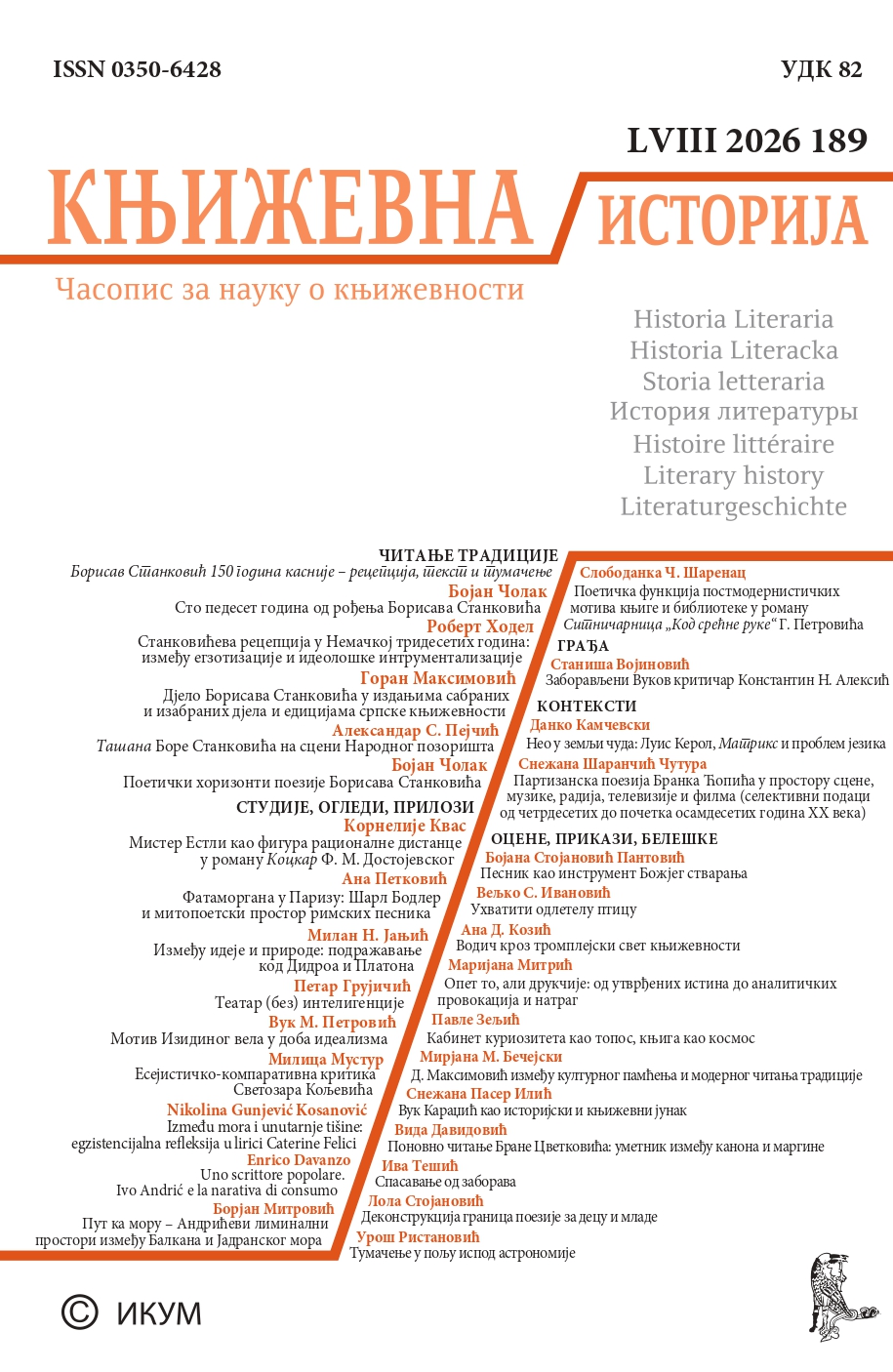
Сва права задржана (c) 2026 Danko Kamčevski

Овај рад је под Creative Commons Aуторство-Nекомерцијално-Без прераде 4.0 Интернационална лиценца.
Аутори који објављују у часопису сагласни су са следећим условима:
- Аутори задржавају своја ауторска права и додељују часопису ексклузивно право првог објављивања научног рада који је истовремено лиценциран под Creative Commons Attribution-NonCommercial-NoDerivatives 4.0 International (CC BY-NC-ND 4.0), што омогућава другима да деле ту интелектуалну својину искључиво у научноистраживачке сврхе уз одговарајуће цитирање на аутора и часопис.
- Аутори имају права да деле своје радове у одговарајућим институционалним репозиторијумима, као и да их накнадно објављују прерађене и уз дораду, али уз обавезну потврду Књижевне историје и напомену о првом објављивању у овом часопису.
- Ауторима је дозвољено, чак се и подстичу да деле радове вирално (нпр. на друштвеним мрежама попут ResearchGate или Academia), што може довести до продуктивне размене научних информација, као и до веће видљивости и цититираности аутора и часописа. (Погледајте The Effect of Open Access).